
Many of the strongest candidates are never actively searching job boards. Understanding why can help employers and recruitment agencies improve hiring outcomes.
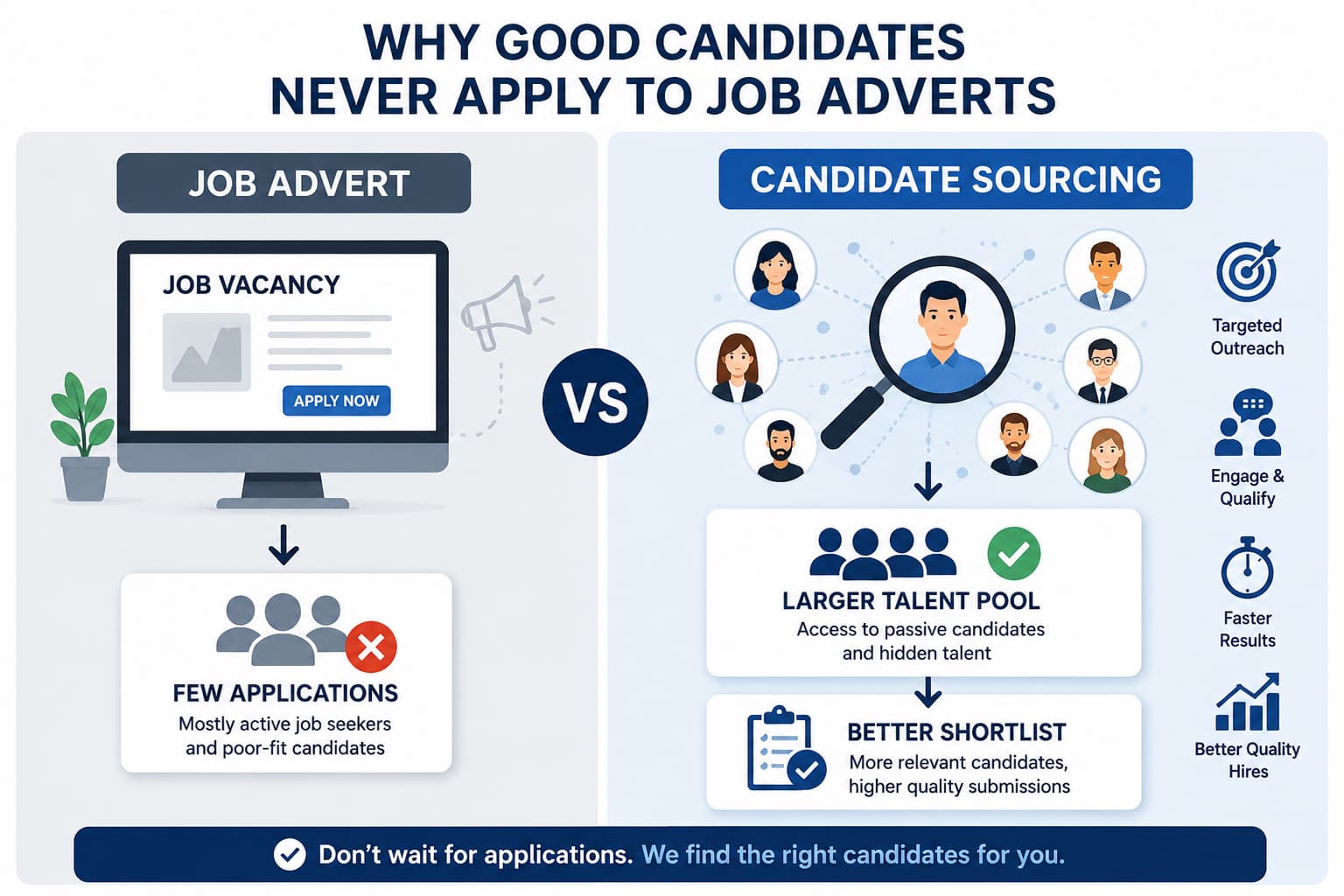
Candidate sourcing helps recruiters reach passive candidates who may never apply through traditional job advertising.
When a vacancy proves difficult to fill, the first instinct is often to increase advertising spend or post the role on additional job boards.
However, many employers and recruiters eventually discover the same challenge: some of the best candidates never apply in the first place.
This is where candidate sourcing becomes increasingly important.
The Best Candidates Are Often Already Employed
Many experienced professionals are already working and are not actively searching job boards every day.
They may be open to the right opportunity, but they are unlikely to spend time completing application forms or browsing multiple job sites.
As a result, relying solely on job advertisements can mean missing a large section of the available talent market.
Why Job Adverts Miss Strong Candidates
Job advertising remains an important recruitment tool, but it has limitations.
Common challenges include:
- Applications from candidates who are not suitable
- Low response rates for specialist roles
- Candidates applying to multiple jobs simultaneously
- Limited visibility among passive candidates
- High volumes of irrelevant applications
For some vacancies, increasing advertising activity simply generates more applications rather than better applications.
What Are Passive Candidates?
Passive candidates are individuals who are not actively applying for jobs but may consider a new opportunity if approached correctly.
These candidates often represent some of the strongest talent available because they are already gaining experience within relevant roles and industries.
Many recruitment agencies focus heavily on passive candidate engagement because it expands the available talent pool beyond active job seekers.
Why Candidate Sourcing Matters
Candidate sourcing focuses on identifying, engaging and qualifying suitable candidates rather than waiting for applications to arrive.
This approach can help employers and recruiters:
- Increase candidate availability
- Reduce dependence on job board applications
- Improve shortlist quality
- Fill difficult vacancies faster
- Access candidates who may not have seen the advert
Rather than relying on chance, sourcing creates a more proactive recruitment process.
The Difference Between Advertising and Sourcing
Job advertising asks candidates to find the vacancy.
Candidate sourcing actively finds candidates who may be suitable for the vacancy.
The most effective recruitment strategies often combine both approaches.
Advertising helps attract active job seekers, while sourcing helps uncover candidates who would otherwise remain invisible to the hiring process.
When Candidate Sourcing Becomes Essential
Candidate sourcing is particularly valuable when:
- The vacancy is urgent
- Previous advertising has failed
- The candidate pool is limited
- Specialist skills are required
- Submission speed is critical
- Recruitment teams are managing multiple vacancies simultaneously
In these situations, waiting for applications alone can significantly slow hiring progress.
How Recruitment Agencies Use Candidate Sourcing
Many recruitment agencies use sourcing activity to supplement job advertising campaigns.
Rather than relying entirely on inbound applications, recruiters actively search for suitable candidates, assess relevance and build shortlists aligned to client requirements.
This approach often improves both submission quality and hiring speed.
How JobMatchedCVs Supports Candidate Sourcing
JobMatchedCVs supports employers and recruitment agencies through targeted candidate sourcing, structured shortlist delivery and recruiter-led candidate identification.
Rather than relying solely on job board applications, we help identify candidates aligned to agreed vacancy requirements, including experience, location, availability and pay expectations.
This provides recruiters and employers with access to a broader candidate pool and helps improve shortlist quality.
Need Help Finding Candidates Beyond Job Board Applications?
Book a short call to discuss how JobMatchedCVs can support your recruitment activity with targeted candidate sourcing and shortlist delivery.
Book a CallEmployer CV Shortlist FAQs
Common questions employers ask when trying to reduce irrelevant applications and improve shortlist quality.
What should employers include in a CV shortlist?
A strong CV shortlist should include relevant experience, location suitability, salary expectations, availability, required qualifications, candidate interest and any key concerns to clarify at interview.
How can employers reduce irrelevant job applications?
Employers can reduce irrelevant applications by using clear job briefs, including pay and location details, adding screening questions and checking candidate suitability before interview.
Why is structured shortlisting important?
Structured shortlisting helps employers save time, reduce internal recruitment workload and focus interview time on candidates who are better matched to the role requirements.
Can JobMatchedCVs help employers shortlist candidates?
Yes. JobMatchedCVs supports employers and recruitment agencies with targeted job advertising, recruiter-led CV search and structured candidate filtering based on agreed role criteria.